
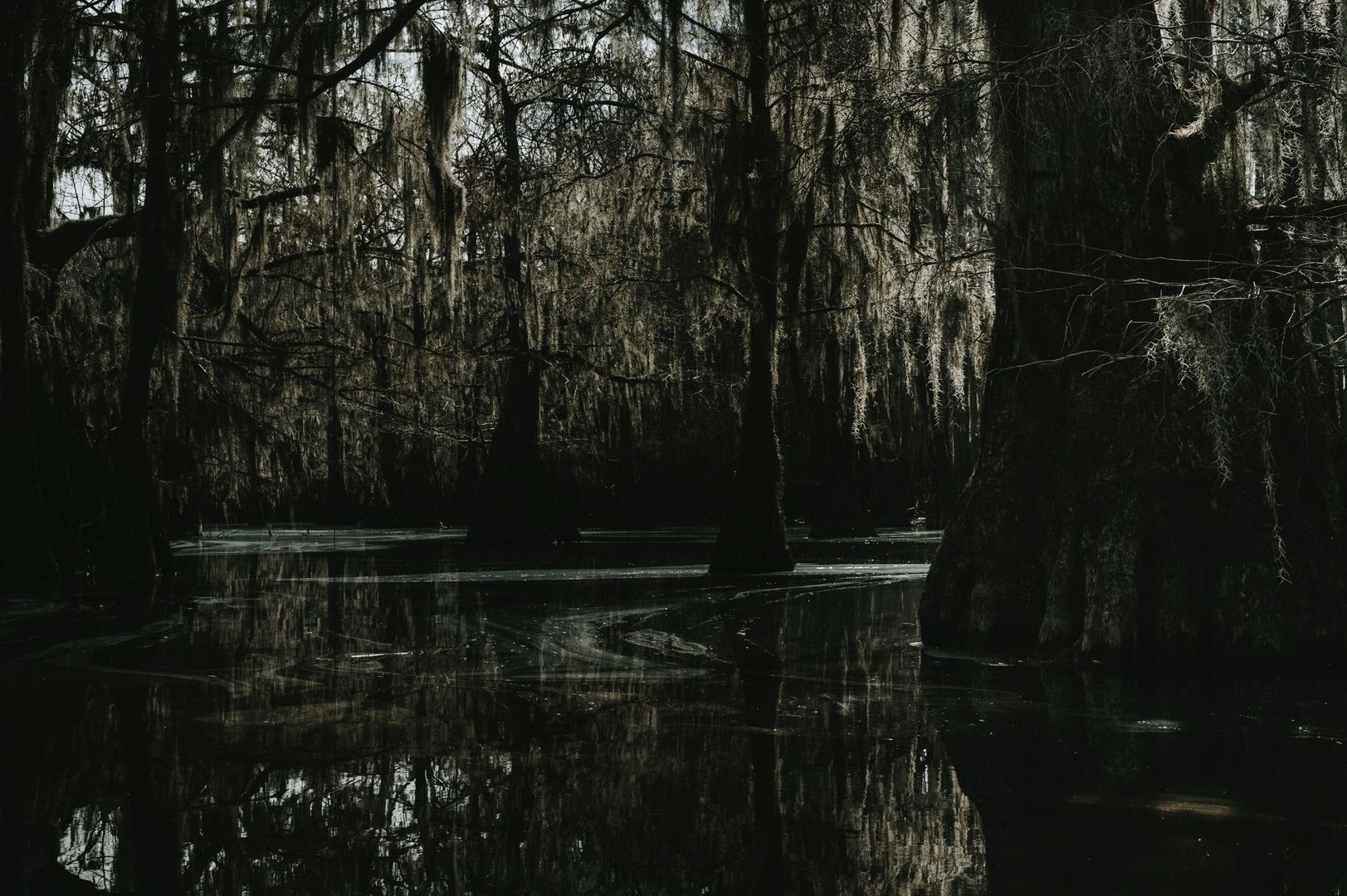
The Alchemical Crucible of the Crescent City
New Orleans sludge metal sounds like weather made audible. It carries the pressure of flooded ground, rusted iron, stagnant heat, and the Mississippi Delta”s long memory. Guitars do not simply play riffs in this setting. They seem to drag them through mud, exposing every splinter, buzz, and wounded harmonic. The result is music with a physical presence, a sound that feels less like entertainment than an encounter with a hostile landscape.
That landscape mattered, but geography alone cannot explain the phenomenon. The crucial collision occurred between Southern blues and rock decay on one side, and the abrasive nihilism of hardcore punk on the other. Black Sabbath supplied the slow, occult gravity. Delta blues supplied repetition, ache, and bent notes. Black Flag supplied the rupture, proving that punk could become brutally slow without losing its sense of danger.
New Orleans musicians did not merely stumble into this combination. They crossed a threshold deliberately, often by refusing the polished rules of conventional metal. Bands such as Eyehategod, Crowbar, Down, Acid Bath, and Soilent Green transformed limited equipment, hostile rooms, and rough personal realities into a regional sigil. Their sludge was not simply a subgenre. It was an alchemical method for turning humidity, anger, addiction, poverty, blues, and feedback into weight.
Southern Decay Meets Hardcore Abrasiveness
The decisive omen arrived in 1984 with the release of Black Flag”s My War. Its second side abandoned the expected velocity of hardcore and descended into massive, uncomfortable repetition. Songs such as “Nothing Left Inside,” “Three Nights,” and “Scream” stretched punk”s nervous energy across slow, punishing structures. The record was initially met with hostility by listeners who expected speed, yet its refusal became its legacy. It demonstrated that hardcore could become a doom engine without surrendering its confrontational spirit.
The record”s importance lies in its tension. Black Flag did not simply imitate Black Sabbath, and the result was not traditional doom metal with punk clothing. The riffs remained blunt and antagonistic, while the pacing created a sense of physical entrapment. The history of sludge metal is often traced to this exact intersection between Black Flag-era punk and Sabbath-derived doom, with the Melvins acting as a vital bridge between the two traditions.
New Orleans musicians absorbed that bridge through several channels. Jimmy Bower has discussed the importance of outlaw country, Lynyrd Skynyrd, John Lee Hooker, the Melvins, and the broader musical culture of New Orleans and nearby Mississippi. These influences did not function as a tidy playlist. They became a vocabulary of rhythm. Southern rock contributed riff shapes and swagger, blues contributed repetition and expressive bends, while hardcore contributed suspicion toward virtuosity and a willingness to sound damaged.
Across regional dive venues, Eyehategod, Crowbar, and Acid Bath gave those materials different forms. Eyehategod made corrosion itself feel like an instrument, combining punk hostility with blues licks and drugged, unstable atmospheres. Crowbar emphasized crushing sustain, mournful melody, and monumental density. Acid Bath moved through sludge, psychedelic dissonance, and grotesque lyrical imagery with a volatility that resisted neat classification. The scene was connected by geography and shared bills, but its bands were never identical.
- Eyehategod sharpened the genre”s hostile, improvised, noise-saturated edge.
- Crowbar expanded sludge into mournful, crushing heaviness with greater melodic gravity.
- Acid Bath pushed toward surreal, psychedelic, and psychologically unstable extremes.
- Down brought Southern rock instinct and heavy groove into a wider metal audience.
The Sonic Architecture of Murk and Feedback
Sludge”s physical architecture begins with the guitar. Down-tuning lowers the center of gravity, but pitch alone does not create the sound. Loose string tension makes attacks feel unstable, allowing notes to sag, scrape, and bloom rather than arrive with clean precision. In a raw recording, the amplifier becomes part of the composition. Speaker rattle, overloaded preamps, room reflections, and imperfect microphone placement all contribute to the final mass.
Feedback is equally deliberate. In polished metal, unwanted resonance is usually treated as a technical problem. In sludge, shrieking feedback can function as a lead instrument, a transition, or an omen. It occupies the air between riffs and makes silence feel electrically charged. The player controls distance from the speaker, guitar angle, sustain, and volume, turning instability into ritual. The resulting noise is not an absence of musical intention. It is the texture that carries the intention.

- Lower the tuning to create room for sustained, heavy intervals, while preserving enough attack for the riff to remain legible.
- Allow mechanical imperfection through loose timing, uncontrolled resonance, and rough amplifier response.
- Use feedback as structure, placing it before a riff, between sections, or after a vocal phrase to extend tension.
- Shape the drums around weight, moving between hardcore acceleration and slow, swinging impact instead of maintaining one fixed pulse.
Drums provide the genre”s changing weather. A D-beat or fast hardcore passage can create panic, but the return to a dragging groove makes that panic feel trapped inside something larger. Eyehategod”s music often gains power from this contrast, moving from frantic attack into a lurching, blues-inflected crawl. The groove is not smooth. It stumbles, leans, and threatens to collapse, yet the instability becomes a form of control.
Contrasting the Waves: Punk Speed Against Delta Weight
The difference between conventional 1980s American hardcore and New Orleans sludge is not simply a matter of tempo. It concerns how each style treats the body, the riff, and the source of conflict. Hardcore often turns speed into a weapon, compressing political anger and social frustration into short, direct bursts. NOLA sludge stretches that confrontation until it becomes environmental, psychological, and almost geological.
| Element | 1980s American hardcore | New Orleans sludge metal |
|---|---|---|
| Tempo | Frequently fast, compact, and propelled by D-beats or thrash-like acceleration | Shifting between frantic attacks, mid-tempo grooves, and agonizingly slow crawls |
| Riff design | Direct power-chord movement with emphasis on momentum | Down-tuned blues figures, dissonance, repetition, and extended sustain |
| Lyrical focus | Political rebellion, alienation, social control, and collective anger | Addiction, systemic decay, hard living, despair, violence, and personal collapse |
| Vocals | Shouted, urgent, and often intelligible enough to deliver a declaration | Howled, vomited, buried, or distorted until the voice becomes another layer of damage |
| Emotional effect | Immediate confrontation and mobilization | Entrapment, exhaustion, dread, and grim persistence |
In place of constant minor-pentatonic speed runs, sludge often uses mid-tempo blues intervals. A bent note may hang longer than expected. A riff may repeat until its original shape dissolves into atmosphere. That repetition recalls the blues, but the emotional destination is darker. The blues traditionally transforms pain through form and phrasing. Sludge leaves the wound open, allowing distortion and volume to become part of the testimony.
Spaces That Forged the Sound Across the Delta
Early sludge required rooms that could tolerate disorder. Small, humid clubs and dive venues gave bands enough proximity to make the audience feel every amplifier failure and every drum hit. In such spaces, volume was not a spectacle viewed from a safe distance. It was a pressure system. Sweat, smoke, beer, cables, and concrete shaped the performance as much as the written riff.
New Orleans also offered an unusually dense musical ecosystem. Jazz, blues, funk, zydeco, bounce, brass traditions, punk, and rock coexisted across neighborhoods and venues. That variety encouraged musicians to treat genre boundaries as porous rather than sacred. A band could carry the rhythmic intelligence of a drummer raised around jazz, the phrasing of Southern rock, and the confrontational posture of hardcore without explaining the mixture to anyone.
The city”s live culture remains broad and neighborhood-specific. A useful guide to New Orleans live music venues describes rooms ranging from historic Uptown stages and intimate listening spaces to dark dive bars and the concentrated club corridors of Frenchmen Street and Saint Claude Avenue. These venues are not interchangeable, but together they reveal the conditions that allow local music to develop through repeated contact, shared bills, and audience loyalty.
- Small rooms magnified the relationship between amplifier volume, audience movement, and performer risk.
- Mixed musical neighborhoods encouraged cross-pollination rather than strict subcultural isolation.
- Local bills allowed emerging bands to refine a sound before outside expectations could standardize it.
- Independent recording conditions preserved rough edges that a larger studio might have corrected.
The surviving artifacts carry those conditions forward. Eyehategod”s Take as Needed for Pain feels hostile partly because its sound refuses cosmetic repair. Jimmy Bower has described the band”s early access to its own equipment as important to its development, while also emphasizing a shared love of blues, old hardcore, and noise. The album”s atmosphere emerges from young anger, deliberate wrongness, and a preference for raw impact over polished definition.
Acid Bath”s When the Kite String Pops extends the same regional darkness into a more volatile and psychedelic register. Its production allows riffs, vocals, and atmosphere to collide rather than settle into clean separation. These recordings remain valuable to audio engineers because their power does not depend on perfect frequency balance. The mud is part of the message. Excessive cleanup can remove the very friction that makes the music convincing.
Carrying the Heavy Legacy Beyond the Swamps
New Orleans sludge permanently widened the boundaries of extreme heavy music by proving that heaviness could be unstable, regional, and emotionally contaminated. It did not require technical display or immaculate production. A riff could be simple yet devastating if the timing, tone, room, and attitude aligned. That lesson traveled into doom, post-metal, stoner metal, noise rock, and later hardcore scenes, where atmosphere became as important as aggression.
Contemporary bands continue to inherit the threshold-crossing method. Some emphasize colossal dynamics and long-form tension. Others return to the short, violent riff or the damaged vocal. Across these variations, the central principle remains intact: sound should carry the conditions that produced it. Sludge metal is therefore best heard not as a museum category, but as an unyielding encounter with physical environment and human grit. The swamp is never merely scenery. It is the amplifier, the pressure, and the final guardian of the riff.