
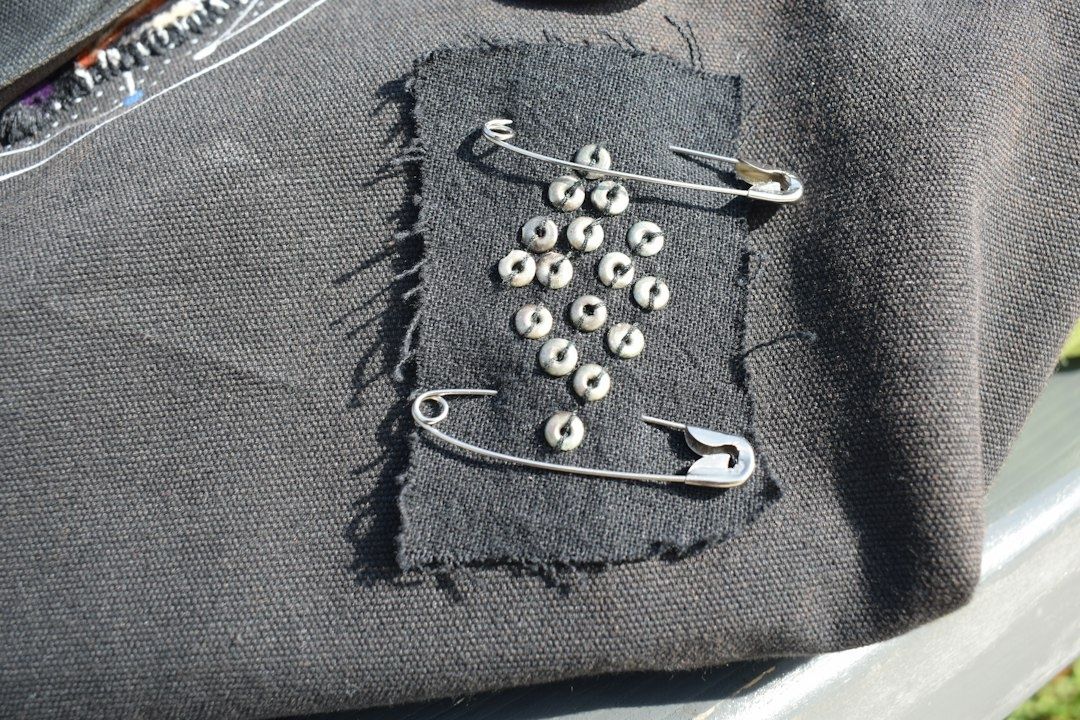
The Armor of Memory and Thread
A battle jacket, often called a kutte, is not merely a denim vest decorated with band merchandise. It is a personal reliquary, a wearable archive in which concerts, friendships, obsessions, political convictions, and years of listening are fixed in cloth and thread. A backpatch may mark the album that changed a life; a frayed tour patch may preserve the heat of a particular venue; a faded insignia may carry the memory of a scene that no longer exists. The garment becomes a record because it is handled, repaired, stained, altered, and worn through time.
Its lineage is atmospheric as much as historical. Wartime flight jackets carried painted images and unit identifiers before motorcycle communities transformed sleeveless leather and denim into declarations of allegiance. Punk then sharpened the form through improvisation, protest, and anti-establishment graphics, while heavy metal made the jacket a dense map of bands, subgenres, and personal canon. Sewing one is therefore a deliberate ritual of memory-keeping. Every patch is selected, every gap negotiated, and every stitch becomes a small act of curation across decades.
Lineage of the Kutte and Subcultural Totems
The modern battle jacket emerged from several overlapping traditions rather than a single origin point. During the Second World War, airmen decorated flight jackets with painted emblems, names, and unit imagery. These garments were practical, but they also made service, danger, and belonging visible. After the war, motorcycle clubs adopted cut-down leather and denim garments as durable surfaces for colors, rockers, emblems, and road histories. By the 1970s, punk seized the same visual language and redirected it toward political slogans, altered clothing, and deliberately abrasive graphics. Heavy metal followed with a strong emphasis on band imagery, album art, skulls, occult symbols, heraldry, and dark fantasy.
The working-class DIY ethic was central to this transformation. A mass-produced jacket could become singular through scissors, dye, paint, studs, safety pins, and hand sewing. The value did not lie only in the finished appearance. It also lived in the labor required to create it. Commercially perfect surfaces could feel less meaningful than crooked stitching, raw edges, and repairs that testified to use. This logic explains why an authentic jacket often looks accumulated rather than designed all at once. It is built through encounters, discoveries, and long periods of listening.
Material culture offers a useful framework for understanding this process. Objects become socially powerful when communities invest them with memory, status, and shared codes. Archaeological approaches to adornment examine how practical materials can communicate identity, affiliation, rank, and belief. The work of Gregory D. Lattanzi, whose academic background includes archaeology, ethnography, material culture, and museum collections management, provides a useful reminder that objects should be read not only for their physical composition but also for the social worlds attached to them.
- Military inheritance: painted emblems and insignia connected clothing to danger, service, and collective purpose.
- Motorcycle transformation: leather and denim became durable signs of mobility, brotherhood, territory, and personal road history.
- Punk intervention: customization became an instrument of dissent, political expression, and resistance to polished mainstream fashion.
- Metal codification: band patches and album imagery created a visual genealogy of taste, loyalty, and underground knowledge.
These traditions also carry responsibilities. Motorcycle club colors, three-piece arrangements, territorial rockers, and one-percent insignia can communicate formal affiliations that do not belong to casual imitation. Independent wearers have broad creative freedom, but cultural literacy matters. A jacket should express genuine connection rather than borrow symbols whose consequences are poorly understood.
Sacred Geometry and the Anatomy of the Canvas
The back of the vest is the architectural altar. A large central backpatch establishes the garment”s visual gravity, much like a crest above a shield. It usually determines the scale, mood, and color direction of everything that follows. Before sewing, place the backpatch on the jacket and examine it from a distance, in a mirror, and while the garment is being worn. The patch must sit comfortably beneath the collar and above the lower hem without obstructing movement or creating a fold that will weaken the fabric.
The upper rocker, when used, frames the central image and creates a horizontal counterweight. Side areas can hold smaller related patches, but they should not compete with the central statement. Breast pockets are useful anchor points for compact logos, memorial patches, or personal symbols. The collar can carry small sigils, though excessive weight in this area may make the jacket uncomfortable. Front layouts benefit from asymmetry that remains visually balanced. Negative space is not emptiness; it is breathing room that allows important patches to retain their force.
| Architectural feature | Minimalist traditional layout | Maximalist crust composition |
|---|---|---|
| Back panel | One dominant backpatch with clear surrounding space | Large central image surrounded by layered patches, paint, and dense stitching |
| Front panels | Two to six carefully spaced patches with balanced visual weight | Many overlapping patches, slogans, pins, studs, and irregular borders |
| Color system | Black, white, and one restrained accent color | High contrast, faded dyes, clashing accents, and deliberate visual abrasion |
| Negative space | Preserved to clarify hierarchy and silhouette | Reduced or eliminated to create pressure and accumulated intensity |
| Growth pattern | Slow additions connected to specific bands or events | Continuous evolution through trades, repairs, political pieces, and found graphics |
Color coordination helps prevent a crowded jacket from becoming visually mute. A dominant field of black and white can support one or two accent colors, while faded red, oxidized silver, or dull gold can echo older patches without making the garment resemble a retail display. A common and effective density range is five to twelve patches, although a two-patch minimalist build and a thirteen-patch full-coverage vest can both be legitimate. The essential measure is not quantity but hierarchy.
The Ritual of Needle and Iron
Hand sewing is the threshold between owning a jacket and making one. Fabric glue and iron-on adhesive can be useful for temporary positioning, but neither has the resilience of thread worked through both patch and garment. Heat can damage synthetic embroidery, leave residue, or weaken old denim. Glue can stiffen cloth and eventually crack. A properly sewn patch can be removed, repaired, or reinforced, preserving the jacket”s ability to evolve.
The necessary tools are modest, but each serves a precise function. A curved upholstery needle helps navigate thick layers and awkward seams. Waxed dental floss offers surprising strength and slides cleanly through dense borders, while bonded nylon thread provides a more conventional, abrasion-resistant alternative. Tailor”s chalk marks temporary alignment lines without permanently staining the fabric. Add sharp scissors, strong pins or clips, a thimble, and a small piece of cardboard to protect the opposite side from accidental needle strikes.
- Prepare the canvas: Remove loose debris and inspect seams, pocket openings, lining, and worn areas. Avoid placing a heavy patch over fabric that is already splitting.
- Map the composition: Arrange every patch before sewing. Photograph the layout, then wear the jacket and check whether the patches shift, collide with the neck, or obstruct pockets.
- Mark the position: Use tailor”s chalk to indicate the top, bottom, and center points. Check that the backpatch follows the jacket”s natural grain rather than twisting across it.
- Baste the patch: Use temporary stitches or pins to secure the patch. Basting prevents creeping, especially when the patch has a stiff embroidered edge.
- Set the tension: Begin on the inside where the knot can be hidden. Pull the thread firmly enough to seat the patch, but not so tightly that the denim puckers.
- Work the border: A close whipstitch is effective for embroidered edges. Pass the needle through the patch edge and jacket, keeping the stitches evenly spaced. For a flat printed patch, a running stitch around the perimeter can distribute stress more gently.
- Reinforce pressure points: Add extra stitches at corners, narrow points, and areas near armholes or pockets. These locations experience repeated flexing.
- Finish securely: Tie off on the interior with several small knots, then bury the thread tail between layers if possible. Trim only after checking the entire seam.
Work slowly around pockets and side seams. A stitch that looks perfectly secure on a table can become a snag when the jacket is worn at a crowded show. For especially heavy leather, pre-punching tiny holes may reduce strain on both needle and material, but the holes must remain close to the patch edge. The craft rewards patience because durability is created through controlled tension, not brute force.
Preserving the Living Artifact for Future Eras
A battle jacket should show its life, but not be sacrificed to it. Sweat, rain, smoke, beer, dust, and abrasion can become part of the garment”s visible history, yet moisture and grime also encourage mildew, dye transfer, corrosion, and fiber breakdown. Patina is meaningful when it records use; deterioration is different when it destroys the evidence. The preservation goal is not to make the jacket look new. It is to keep the existing story legible.
Cleaning should begin with the least aggressive method. Air the jacket in a shaded, well-ventilated place rather than direct sunlight. Brush away dry dirt with a soft garment brush. For denim, test a barely damp cloth on an inconspicuous area before treating a mark. Blot rather than scrub, and avoid soaking embroidered patches or painted surfaces. Vintage leather requires particular restraint. A conservator-approved leather conditioner may be appropriate, but excessive oil can darken leather, soften structural fibers, stain embroidery, and attract dust. When a jacket contains fragile textiles, metal studs, old paint, or severe cracking, professional advice is safer than a vigorous home treatment.
Preservation practices used for historic textiles offer a sound model. The guidance in Beyond the Book: Textiles emphasizes stable environmental conditions, pest management, light protection, chemically stable storage, and careful handling. A concert-worn garment deserves the same respect on a smaller scale, especially when its fabric has already been weakened by years of movement.
- Control the environment: Store the jacket in a cool, dry, stable room away from radiators, damp walls, and abrupt temperature changes.
- Reduce light exposure: Prolonged sunlight can fade denim, leather, thread, and printed imagery. Display the jacket briefly and rotate its position.
- Support the shape: Use a broad, padded hanger for sturdy garments, or store the jacket flat if its weight is pulling on fragile shoulders.
- Choose stable materials: For folded storage, use acid-free tissue to pad creases and support three-dimensional patches, studs, and collars.
- Inspect periodically: Look for mildew, insect activity, rust, loose threads, and adhesive failure before problems spread.
- Document the archive: Photograph the jacket, record patch origins, and note repairs so its chronology survives even if a piece is later replaced.
Never store a damp jacket in plastic. Allow it to dry completely, but avoid high heat, hairdryers, and aggressive pressing. If a jacket has mold, extensive leather damage, valuable vintage patches, or severe structural weakness, a textile conservator is the correct guardian. The expense of consultation may be small compared with the permanent loss of a garment that cannot be replaced.
Carry Your History Upon Your Shoulders
A battle jacket is an evolving autobiography written without paper. Every stitch anchors a venue, a record, a friendship, a season, or an era of personal transformation. Its imperfections are not defects to be erased automatically. They are evidence of contact with the world, provided that the underlying cloth remains strong enough to carry the next chapter.
Additions should therefore be deliberate acts of curation rather than impulsive overfilling. Leave space for future discoveries. Repair before decorating over damage. Learn the meanings of symbols before wearing them. Then keep the jacket in motion: take it to shows, protect it from needless neglect, and pass it on when its archive has outgrown one set of shoulders. In denim, leather, thread, and fading color, heavy metal history becomes something tactile, portable, and alive.