

The Accidental Alchemy of the Stockholm Buzzsaw
In the late 1980s, Stockholm”s death metal scene grew in rehearsal rooms, basements, youth clubs, and battered tape-trading networks. The music was fast, primitive, and ambitious, but its most recognizable feature was not a compositional rule. It was a sound: a serrated guitar texture that seemed to grind through the speakers like a mechanical saw tearing into rusted steel. At the center of that emerging language stood Sunlight Studio, where limitations, improvised methods, and a willingness to tolerate ugliness became part of the artistic vocabulary.
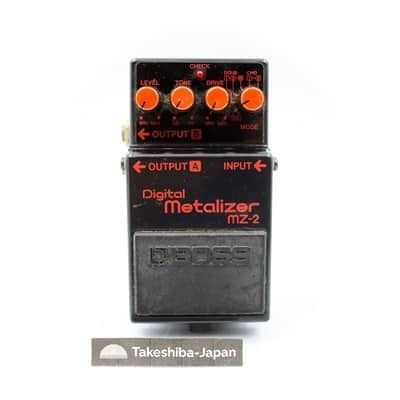
The mythology often reduces the formula to one orange-and-black pedal, but the real alchemy was a chain of interacting failures. A guitar pickup drove a distortion circuit beyond polite operating conditions, a cheap solid-state amplifier supplied a hard and unforgiving canvas, and the cabinet restrained the resulting low-frequency chaos. The famous Stockholm studio tradition did not pursue immaculate fidelity. It discovered that clipping, frequency collisions, speaker limits, and room-level decisions could create a coherent identity when pushed together with conviction.
The Black-and-Orange Relic and the Maxed-Out Sigil
The Boss HM-2 Heavy Metal became the central talisman of the Swedish chainsaw sound, but its importance lies in circuit behavior rather than brand mythology. The pedal combines multiple gain stages with active equalization, including two gyrator-based mid-frequency sections that shape broad, forceful bands rather than applying a delicate studio curve. Those filters help create the familiar balance of swollen lows, aggressive upper mids, and a cutting high-frequency edge. The result is not simply “more distortion.” It is a frequency-dependent overload in which the equalizer and clipping stages continually provoke one another.
The classic ritual is blunt: set Level, Low, High, and Distortion fully clockwise. This setting is often called “dimed,” and it matters because the pedal”s identity emerges when every control contributes maximum pressure. The Level control slams the amplifier input, the Low and High controls exaggerate the filter network”s tonal contour, and Distortion drives the pedal”s clipping stages into a dense, compressed mass. A restrained setting can sound like an ordinary vintage distortion. The fully opened setting crosses a threshold into something more unstable and more useful.
Conventional distortion theory would predict increased saturation, compression, and harmonic density, but it does not fully explain the chainsaw sensation. The ear perceives the sound as a moving band of abrasive energy because the boosted midrange remains present even after the lows are compressed and the highs become harsh. Descriptions often place a major emphasis around roughly 1.3 kHz, though the exact peak changes with the pedal, guitar, amplifier, speaker, recording chain, and measurement method. That region is crucial because it supplies articulation to palm-muted riffs while keeping the guitar audible through dense drums and bass.
- Low-frequency exaggeration creates weight, but the amplifier and speaker determine how much of it survives.
- Midrange emphasis gives riffs their grinding vocal quality and prevents the guitar from disappearing.
- High-frequency distortion adds the splintered edge associated with the buzzsaw metaphor.
- Maximum control settings turn the pedal into a nonlinear system rather than a transparent tone-shaping device.
The enduring reputation of Entombed”s Left Hand Path reflects how effectively this architecture served songwriting. As documented in a detailed retrospective of the album, the sound was not merely hostile. It carried punk-derived momentum, chunky grooves, catchy movement, and an almost physical sense of fun. The distortion became a sigil, but the riffs gave that sigil a body.
Tomas Skogsberg and the Sunlight Studio Anvil
Tomas Skogsberg”s role at Sunlight Studio was less about applying a fixed recipe than recognizing what the scene already wanted to become. His engineering philosophy was exploratory and practical. Each session presented a new problem, and the studio became a place where musicians could test the limits of equipment without being forced toward polished conventionality. The legendary tone emerged from that attitude. It was not a laboratory recreation of an abstract ideal. It was a group of people hearing that something sounded violently right and deciding not to correct it.
Leif “Leffe” Cuzner is frequently associated with the discovery of the crucial guitar setup, involving the HM-2 and an inexpensive Peavey amplifier. Once that combination revealed its power, Sunlight helped turn a local experiment into a recognizable production language. Entombed”s Left Hand Path and Dismember”s Like an Ever Flowing Stream remain essential landmarks, although they do not sound identical. The Dismember record”s rushed sessions and landmark guitar tone became part of its character, as the band later recalled in a track-by-track account of the album.
The distinction between this method and modern production is revealing. Contemporary metal often relies on high-headroom interfaces, precisely modeled amplifiers, carefully edited performances, multiple layered guitars, and extensive post-production. Such tools offer control, but control can also separate cause from effect. At Sunlight, the guitar tone was born as a complete physical event. The pedal pushed the amplifier, the amplifier pushed the speaker, the speaker interacted with the cabinet, and microphones captured the collision.
| Sunlight-era approach | Modern high-control approach |
|---|---|
| Cheap, characterful amplifier | Modeled or boutique high-gain amplifier |
| Extreme pedal settings | Detailed plugin and EQ automation |
| Limited tracking and editing | Layered, edited, and tightly aligned performances |
| Sound shaped before the microphone | Sound frequently refined after capture |
| Imperfection treated as identity | Imperfection often treated as a problem to solve |
That contrast should not become a false opposition. Modern tools can reproduce the architecture convincingly, but authenticity depends on preserving interaction. A perfectly isolated pedal plugin, a surgically gated amp, and a sterile cabinet impulse response may contain the correct ingredients while missing the unstable pressure that made the original recordings feel alive.
The Solid-State Canvas and Peavey Foundations
The commonly cited Peavey Bandit 112 was not chosen because it represented luxury. Its value was precisely the opposite. A cheap solid-state amplifier offered a relatively direct, unforgiving response, with less of the soft compression and harmonic bloom associated with a loud tube head. When an HM-2 was placed in front and driven hard, the transistor amplifier did not politely round off every sharp edge. It acted as a rigid anvil against which the pedal”s abrasive waveform could strike.
This pairing also explains why simply placing an HM-2 before an expensive tube amplifier may produce a powerful tone but not the same tone. A tube circuit can add desirable warmth, sag, and dynamic smoothing. The chainsaw character often benefits from the absence of those comforts. The solid-state amp leaves the pedal”s upper-mid aggression exposed, while its speaker and cabinet impose the physical limits that keep the low end from becoming an unusable cloud.
- Use a solid-state or tightly controlled amplifier model as the initial canvas.
- Avoid excessive preamp gain after the pedal, since too much additional saturation can erase pick definition.
- Listen to the cabinet as part of the distortion system, not as a neutral finishing stage.
- Keep enough low end for impact, but remove sub-bass that the original small speaker could never reproduce cleanly.
Speaker breakup is especially important. The cabinet does not reproduce every frequency equally, and its resonances create peaks and dips that become part of the recorded fingerprint. A small or modestly voiced speaker limits deep bass, focuses the low mids, and turns the HM-2″s exaggerated spectrum into something that can occupy a mix. The apparent “mud” is therefore tethered by hardware. Remove the tether with a full-range system and the same pedal settings may become indistinct.
Recreating the Ritual in the Modern Production Realm
Digital tools make the Swedish architecture accessible, but they also make it easy to overbuild. The goal is not to stack every available distortion, amp, cabinet, and equalizer plugin. The goal is to recreate the order of pressure and preserve the points where nonlinear behavior matters. Start with the instrument, then move through the pedal, amplifier, cabinet, microphone or impulse response, and only afterward apply corrective processing.
- Prepare the source. Use a guitar with clear pickups and fresh strings. Tune accurately, control unnecessary noise, and record a consistent performance. Extremely hot active pickups may require lower input gain than expected.
- Manage input impedance. A real pedal sees the guitar through a particular input circuit. If using hardware, place the HM-2 early in the chain. If using software, choose an input or pedal model that does not unintentionally load the guitar or dull its high end.
- Set the pedal as a starting ritual. Begin with Level, Low, High, and Distortion at maximum. Reduce only when the recording demands more clarity. The point is to reach the signature operating zone before making cosmetic adjustments.
- Choose the amplifier canvas. Try a Peavey Bandit-style solid-state model or another clean, firm transistor platform. Keep amp gain moderate enough that the pedal remains the primary source of violence.
- Select the cabinet impulse response. Test smaller, tighter cabinets and microphones with useful midrange presence. If the impulse response produces excessive fizz, use a gentle high cut rather than burying the entire tone under broad filtering.
- Shape the mix position. High-pass cautiously, control any woolly low mids, and inspect the 1 kHz to 1.5 kHz region. A narrow boost may exaggerate the signature, but a broad, moderate contour usually survives layered guitars more naturally.
Analog gain staging remains relevant inside a DAW. Avoid clipping the interface input unless the hardware is intentionally being used as part of the sound. Instead, place the pedal model at a healthy level, monitor the amplifier input, and verify that each plugin receives the signal range for which its circuit model was designed. Some emulations react dramatically to input level, while others are calibrated closer to nominal studio operating levels.
Modern users frequently blend a dry amp signal with a pure HM-2 fuzz or a parallel distortion path. That can add body, but it introduces timing and phase risks. Different plugins may model latency, filtering, and cabinet behavior differently. Nonlinear phase anomalies can create hollow mids, smeared attacks, or unexpected cancellations when the paths are combined. Align tracks by plugin delay compensation, check polarity, and audition the blend in mono. If the parallel path sounds larger in isolation but thinner in the mix, the signal is likely fighting itself.
A practical approach is to keep one main chainsaw path and use the parallel signal sparingly. If additional definition is needed, a cleaner amp layer with carefully chosen high-pass and low-pass filters may be more stable than blending two heavily distorted paths. Some modern discussions suggest using a pedal-emulation stage, an EQ shaped toward HM-2-like frequencies, and a separate amp-and-cabinet stage, with cuts and boosts adjusted by ear rather than treated as sacred numbers. That principle is sound: the exact curve is less important than the interaction between spectrum, gain, performance, and arrangement.
Wielding the Chainsaw Legacy in Contemporary Audio Craft
The Swedish buzzsaw architecture escaped its original scene because it solved a universal problem: how to make guitars feel enormous without making them smooth. Its influence can be heard in grindcore, crust, hardcore, death”n”roll, and modern metal revival recordings. The sound remains effective because it carries motion and friction. Every pick attack produces a small rupture, and every sustained chord contains a cloud of related harmonics that feels more like machinery than decoration.
The deeper lesson is not that every producer should use an HM-2 at maximum settings. It is that technical flaws can become artistic signatures when they are repeated with intent. The imperfect circuit, the cheap speaker, the overloaded input, and the limited studio environment were not individually magical. Together, under the pressure of strong riffs and decisive engineering, they crossed a threshold. That threshold still offers a challenge to contemporary practice: do not automatically repair every harshness, flatten every dynamic irregularity, or replace every constraint with a cleaner option.
Begin with the sound as a physical event, then decide what the mix truly needs. Let the guitar retain a little danger. Test the chain at rehearsal volume, inspect it in mono, and judge the tone against the drums and bass rather than in soloed isolation. The chainsaw legacy belongs to anyone willing to treat the signal path as a forge, where equipment abuse, harmonic resonance, and disciplined restraint can produce a voice that no pristine preset could summon.