
Crossing the Threshold of Extreme Percussion
Extreme metal percussion begins with a paradox. The sound suggests collapse, a storm of snare, cymbal, and bass drum that seems to abandon structure in favor of pure aggression. Yet the most convincing blast beats are not uncontrolled walls of noise. They are disciplined systems in which every limb occupies a precise station, every stroke is economized, and every acceleration is governed by rhythmic intent. Beneath the violence lies an almost architectural calm.
That design becomes clearer when the drummer moves beyond familiar rock archetypes. Standard backbeats depend on a recognizable relationship between kick, snare, and cymbal. Extreme metal stretches that relationship toward hyper-speed velocity, often demanding sustained coordination at tempos above 240 beats per minute. The journey from early acoustic innovations to the modern blast beat is therefore not merely a story of louder playing. It is the forging of kinetic efficiency, limb independence, endurance, and arrangement into a single percussive sigil.
The Ancestral Forge from Jazz Innovations to Double-Bass Warfare
The modern extreme-metal foot technique rests on an older mechanical revolution. Bass drum pedals were developed partly to save space in pit orchestras, allowing one performer to coordinate hands and feet without requiring a dedicated bass drummer. Ludwig manufactured a spring-loaded pedal in 1909, helping establish the basic mechanism that made simultaneous limb control practical. Around 1939, jazz drummer Louie Bellson conceived a two-bass-drum setup, and Gretsch later built an exceptionally large kit for him in 1946. At first, the visual drama and solo potential of the arrangement mattered as much as its rhythmic function.
That vocabulary gradually entered aggressive rock. Ginger Baker, Keith Moon, and Mitch Mitchell demonstrated how expanded drum layouts could become part of a drummer’s musical identity rather than a novelty. During the 1970s, Carmine Appice and Billy Cobham pushed double-kick playing into shuffles, articulated grooves, and intricate arrangements. The distinction between two bass drums and a double pedal also became important. Two drums can offer a particular response and tonal separation, while the twin pedal introduced by Sleishman in 1968 made coordinated bass-drum work more accessible to players using a single drum.
Metal transformed that foundation from spectacle into infrastructure. By the 1980s and 1990s, players such as Slayer’s Dave Lombardo helped establish double bass as a major timekeeping and speed device. The feet were no longer reserved for dramatic fills. They became a continuous engine beneath riffs, tremolo-picked guitars, and dense vocal phrasing. The crucial transition was from heavy, heel-down shuffles toward alternating strokes across two pedals, with each foot treated as an independent rhythmic voice.
- Heel-down control: useful for quiet dynamics, slower grooves, and developing ankle awareness.
- Full-leg drive: effective for powerful accents and initial speed development, but costly when sustained.
- Alternating pedal strokes: the central architectural principle behind continuous double-bass patterns.
- Separate rhythmic roles: treating each foot as an individual voice prepares the body for polymetric writing.
This coordination became the architectural groundwork for extreme tempos. Before a drummer can divide a blast beat into independent layers, the feet must stop behaving like a single heavy mechanism. The lower body has to produce a stable, even pulse while the hands create another surface above it. Double-bass warfare is therefore less about brute force than about converting impact into repeatable information.
Anatomy of the Modern Blast Beat Architecture
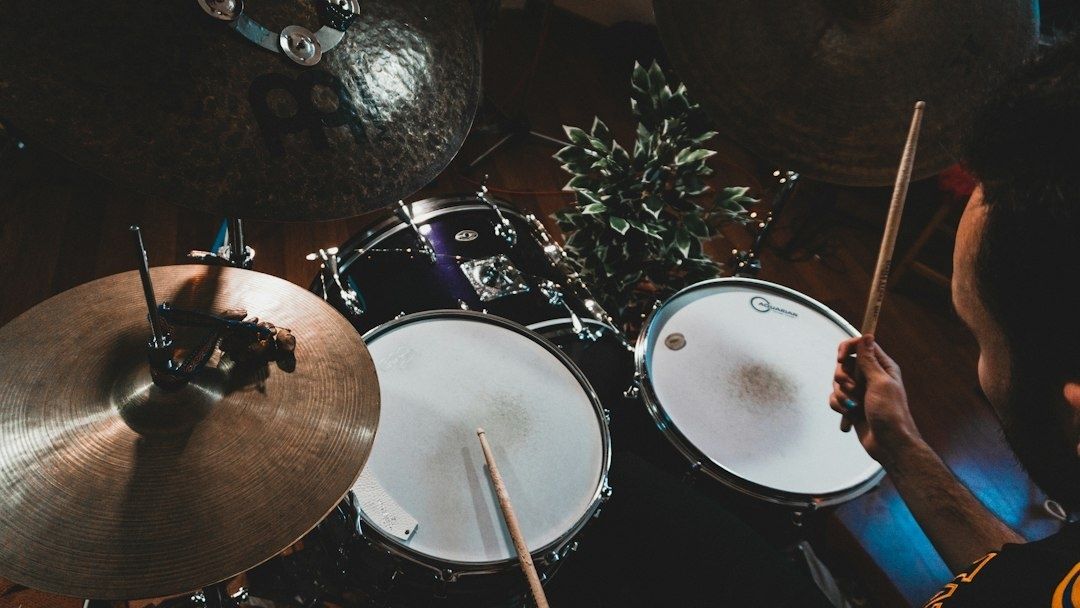
A blast beat is best understood as a family of related designs rather than one fixed pattern. In a traditional blast, the snare and bass drum commonly align with alternating or closely related cymbal strokes, creating a relentless forward stream. The bomb blast emphasizes heavier bass-drum punctuation and a more forceful low-end profile. Hyper blasts increase density and continuity, while freehand approaches redistribute the work between hands and feet so that the drummer can sustain speed with less muscular strain. The terminology varies across players and schools, but the underlying question remains constant: which limb carries the pulse, and how are the remaining limbs layered around it?
At tempos exceeding 240 BPM, synchronization becomes a biomechanical problem. A quarter-note pulse at that speed already demands fast, even repetition. If the hands articulate eighth or sixteenth-note subdivisions while the feet maintain their own stream, tiny inconsistencies become immediately audible. The snare cannot simply be struck harder to compensate. Its placement must remain stable, its rebound must be controlled, and its relationship with the kick must survive the transition between accents and unaccented strokes.
Instructional material on blast-beat development commonly treats speed, coordination, endurance, independence, balance, and breathing as connected skills. That connection matters. A drummer who increases tempo without controlling breath often stiffens the shoulders, raises the sticks too far, or drives the pedals from the hips long after the movement has become inefficient. Historical documentation of the blast beat also shows how speed metal and grindcore pushed percussive velocity beyond conventional boundaries, while later death-metal approaches refined the patterns into a broader language of texture and meter. A useful overview appears in this historical account of blast beats.
| Blast archetype | Typical emphasis | Resulting texture |
|---|---|---|
| Traditional blast | Coordinated snare, cymbal, and bass-drum motion | Continuous, cutting wall of sound |
| Bomb blast | Heavier or more prominent bass-drum punctuation | Low-end impact beneath violent upper-register attack |
| Hyper blast | High-density, sustained subdivision | Compressed intensity with minimal rhythmic space |
| Freehand blast | Redistribution of work through hand technique | Greater endurance and fluidity at extreme speed |
The table is not a set of rigid laws. It is a diagnostic map. When a pattern collapses, the player can ask whether the problem lies in the hand pattern, the foot pulse, the accent structure, or the physical method used to produce each stroke. That distinction turns a mysterious threshold into a solvable engineering problem.
Rhythmic Polyrhythms and Limb Independence Rituals
Extreme metal inherited more than speed from jazz and fusion. It inherited the idea that each limb can sustain a distinct musical statement. A ride cymbal ostinato may imply one pulse, the feet may establish another, and the snare may interrupt both with displaced accents. In death metal, this independence allows a riff to change meter or accent pattern without forcing every limb to restart. The drummer becomes a guardian of several simultaneous clocks.
Polyrhythm is not simply fast playing with extra notes. It is the coexistence of contrasting metric pulses, a concept explained clearly in this reference on layered polyrhythm. The practical challenge is to keep the layers distinct while preserving a shared subdivision. If the lower body plays an even stream of alternating kicks and the right hand maintains a ride pattern grouped in threes, the nervous system must recognize both the common grid and the different groupings imposed upon it.
- Build one limb at a time. Play the foot ostinato slowly until every stroke has equal spacing and controlled volume.
- Add a neutral upper pulse. Use quarter notes on the ride or hi-hat before introducing complex subdivisions.
- Introduce contrasting groupings. Add triplets, displaced snare accents, or a three-note hand figure over a four-note foot cycle.
- Reduce the tempo when tension appears. Speed gained through stiffness is unstable and will collapse under performance pressure.
- Remove the click temporarily. Test whether the internal pulse survives without external correction, then return to the metronome for verification.
Layered practice should also include dynamic separation. Make the bass pulse quiet while the snare remains pronounced, then reverse the relationship. This teaches the limbs to operate independently not only in time, but also in volume and tone. The result is greater control over arrangement. A blast beat can function as a single mass, a conversation between upper and lower limbs, or a shifting field of accents that follows the guitar rather than merely doubling it.
The Ergonomics of Speed and Kinetic Economy
At extreme tempos, the smallest useful movement becomes a form of power. Micro-fulcrum stick control uses the fingers and the natural rebound of the drumhead instead of lifting the entire forearm for every note. French grip, with the palms oriented more vertically, can support rapid finger-led motion and precise adjustment of the stick angle. Neither technique is a magical identity. Both are tools for reducing unnecessary travel while preserving sound quality and control.
The feet undergo a similar evolution. Full-leg drive can provide force, but sustained hyper-speed playing often requires a transition toward ankle motion, controlled heel positioning, or swivel techniques that distribute effort across the foot and lower leg. The correct choice depends on anatomy, pedal setup, desired tone, and musical context. The governing principle is simple: if a movement produces more fatigue than sound, it is spending energy without serving the pattern.
- Keep stick heights low when the music does not require large accents.
- Allow the drumhead and cymbal to provide rebound rather than fighting the rebound.
- Separate power practice from endurance practice, since maximum volume and maximum duration demand different mechanics.
- Monitor shoulder, wrist, hip, and ankle tension before discomfort becomes injury.
- Use short, repeatable intervals at high speed, followed by deliberate recovery.
Energy conservation is not a retreat from aggression. It is the condition that allows aggression to remain consistent. A performance may contain brief passages of full-leg force, explosive accents, or wide arm motion, but those events gain meaning because the surrounding technique is economical. The most formidable blast beat often looks smaller than expected, like a hidden machine whose output far exceeds the visible movement.
Claiming Mastery over the Outer Limits of Sound
Extreme percussion stands where mechanics, endurance, and composition meet. The feet must generate a dependable engine, the hands must articulate a chosen texture, and the mind must understand how those layers serve the riff. Speed alone cannot create authority. Without balance, a blast becomes a blur. Without dynamic control, every section carries the same weight. Without rhythmic intention, athletic ability turns into ornament.
The practical path forward is deliberate. Choose one blast architecture, isolate each limb, build an even pulse at a sustainable tempo, and increase speed only when the body remains relaxed. Record the result, listen for uneven spacing, and treat every flaw as a map rather than a verdict. The threshold is crossed not through reckless force, but through thousands of precise repetitions. In that discipline, the blast beat reveals its true nature: not chaos, but a crafted storm, forged by a drummer who has taught every limb to speak with its own voice.